ASTR430 Spring 2026 BLOG

Always Click Reload to Update Blog
Post a Message!
Return to the ASTR430 main page
I
encourage you to write about any astronomical topic. Feel free to talk
about homework problems, but do not just broadcast your answers to
others. Your name will appear with what you write. No cussin'!
Blog Post #227. Thu May 7 15:21:21 2026. Evan Shipley-Friedt wrote:
In simulations of star or galaxy formation, is it physically useful to start with a cloud that has little or no net angular momentum and then allow asymmetric mass loss or outflows to leave the remaining bound gas with a disk-like angular momentum? Or is that a less important effect compared with the standard assumption that the cloud already has some angular momentum from initial velocities, turbulence, shear, or tidal torques? I understand why angular momentum has to be conserved, but I am wondering whether disk formation is mostly about initial angular momentum, or about how feedback and outflowing material separate angular momentum from the gas that remains bound.
Blog Post #226. Thu May 7 12:07:55 2026. Oliver O'Brien wrote:
I can't believe today is the last day of class! If anyone's interested in visualizing the Solar System more, I found this really neat tool that lets you add other planets and see how orbits change, which is fun to mess around with!
Blog Post #225. Thu May 7 11:23:29 2026. Ava Allen wrote:
Hi everyone!
I was wondering if our Comet reservoirs will ever "run out"? Like will there ever be so many collisions that there are no more Comets in our Solar System? What is the timescale of this if so?
Blog Post #224. Tue May 5 15:22:02 2026. Zya Woodfork wrote:
Can someone explain in more depth what runaway growth of a planetesimal is? What happens when a planetesimal experiences this?
Blog Post #223. Tue May 5 14:51:42 2026. Oliver O'Brien wrote:
I thought this reading was a bit dense but interesting! I didn't know about the blanketing effect, and it was cool to learn more about how secondary atmospheres form since I've heard about them but never directly learned about the processes that form them. I also liked learning about the brown dwarf desert. Cool stuff overall!
Blog Post #222. Tue May 5 12:42:08 2026. Shane Levay wrote:
These chapters really showed that planet formation is not a smooth process marked by collisions and disk dynamics. If there are so many dynamic barriers to growth, what mechanisms help them survive long enough to become full planets, or is there also some luck involved?
Blog Post #221. Tue May 5 11:29:10 2026. Ava Allen wrote:
Hi Everyone!
To try and answer Oliver's question: yes I believe the greater mass in the giant planets is part of the answer. In our Solar System, it is important to note that the giant planets are also orbiting much further from the sun than the terrestrial planets. L= r x p, so a greater distance means more angular momentum.
Blog Post #220. Tue May 5 11:23:33 2026. Debika Biswas wrote:
Hi everyone!
Jasmin, I think I have a partial answer to your question but would appreciate further clarification about this topic, as I am not completely sure and this is just my interpretation of what is said in the textbook.
From what I understand, runaway growth happens first, and then oligarchic growth happens next. I think runaway growth is associated with smaller bodies and oligarchic growth is for larger bodies.
Otherwise I liked the reading, as I don't know a whole lot on this topic!
Blog Post #219. Sun May 3 16:11:03 2026. Jasmin Mohammadi wrote:
After reading the 15.4 - 15.6 I had a definitional question. What is the difference between runaway growth and origarchial growth? Are these not both just phases of rapid accretion?
Blog Post #218. Thu Apr 30 14:58:15 2026. Yixuan Peng wrote:
The evolution of chemical composition is very interesting, as it was rarely introduced in previous classes. Hydrogen is the most common and frequently occuring element as it is one proton and one electron, lightest and easiest to form. reference 15.2, what about nitrogen and carbon/oxygen and compounds without hydrogen? especially nigtrogen, what property makes it a major element (or at least occurs freqently, in plenty of locations) in a planetary system?
Blog Post #217. Thu Apr 30 13:46:56 2026. Gillian La Vina wrote:
I had a few questions about Virial Theorem. Why is the potential energy twice the kinetic energy, instead of just balancing each other out? Does it have to with the time averages? Also, is virial theorem specific to gravity, or does it apply to forces that scale with the distance in different ways?
Blog Post #216. Thu Apr 30 13:44:02 2026. Oliver O'Brien wrote:
Hi everyone! I thought this reading was definitely interesting! I didn't realize the majority of the small bodies in the Solar System orbited beyond Neptune, but I guess that makes sense considering how much space there is for them to exist in compared to closer in. I also didn't know that the Galilean moon densities decreased with distance from Jupiter! Overall, a lot of this reading was familiar from ASTR 320.
I have 1 question so far:
1. Why does >98% of the angular momentum in the Solar System reside in the orbital motion of giant planets? Is it because the giant planets are the second most massive objects in the Solar System?
Blog Post #215. Thu Apr 30 11:47:31 2026. Ava Allen wrote:
Hi everyone!
This reading was very familiar for me as my research is on Dust Extinction in Dense Molecular Cores! The core in figure 15.1 (Barnard 68) was actually one of my targets for my honors thesis. B68 is a Quiescent Core (meaning no embedded star formation has occurred yet). It was interesting to read about what comes after the focus of my research!
Blog Post #214. Thu Apr 30 10:01:10 2026. Xuge Wang wrote:
If mixing in the Sun’s disk was incomplete, how might that explain the existence of distinct reservoirs (e.g., carbonaceous vs. non-carbonaceous meteorites, or the different compositions of inner vs. outer Solar System bodies)?
Blog Post #213. Thu Apr 30 01:45:59 2026. Jasmin Mohammadi wrote:
I really enjoyed this section of the Planet Formation chapter! I did have a question regarding the magnetic torque. Is the idea that the field interactions lead to the disk and the star corotating which leads to angular momentum being transferred, or is there another mechanism I am missing?
Blog Post #212. Thu Apr 23 14:53:39 2026. Zya Woodfork wrote:
Why does debris around a planet form rings, while debris around the whole solar system is spherical (Oort cloud)?
Blog Post #211. Thu Apr 23 14:48:59 2026. Ava Allen wrote:
Is there enough material in Saturn's rings to form a new moon? Or is it too sparse?
Blog Post #210. Thu Apr 23 14:46:05 2026. Thomas Kenna wrote:
After reading 11.1-11.3, I honestly thought that rings would be a bit more complex but it turns out ring formation just has to do with tidal forces inside a planet's roche limit causing any rocks that enter to rip apart.
Also i think the line in the textbook that Meghan pointed out was very poorly written, hopefully i can word it a bit better. If we have a planet-moon system and we consider a point on the surface of a moon on the side nearest to the planet, it has two forces acting on it. One is the gravitational force of the moon which would pull the point outwards and the other is the gravitational force of the planet which is pulling the point inwards. So, if the moon is close enough to the planet, the gravitational pull of the planet is strong enough to start ripping parts of the moon away.
Blog Post #209. Thu Apr 23 14:42:09 2026. Oliver O'Brien wrote:
Hi all! I'm super excited to learn about planetary rings! I didn't realize that Roche Limits depended on the satellite's density. I'm sure we discussed this in ASTR 320 last year, but I must have forgotten the relationship. I also thought it was super cool that we discovered Uranus' rings because they were occulting stars! Occultations are super interesting to me.
Here are my questions:
1. I was wondering if anyone knew whether moons or rings form first around a planet?
2. How have we not yet detected Saturn's D ring from the ground? I find it hard to believe that we don't have powerful enough telescopes to view it.
3. At what point does a gap in a ring form 2 separate rings? Are rings identified by how they formed or just the fact that they're separate from each other?
4. I feel like I should know this, but what exactly do backscatter and forward scatter mean? Do they reference the angle at which light is hitting something and being viewed?
5. The textbook notes that Uranus' moon Mab could be the source of its μ ring, but it doesn't explain exactly what that means. Does Mab have cryovolcanism similar to Enceladus?
Blog Post #208. Thu Apr 23 12:55:05 2026. Gillian La Vina wrote:
I enjoyed this reading. A few questions on 13.1 and 13.2:
13.1 mentions the Roche limit for tidal disruption. In other astronomy classes, we discussed this mostly in the context of mass transfer between stars in binary star systems, where the material from one star spirals into the other. In comparison, what makes Saturn’s rings more “stable” e.g. not spiraling inward? Is it spiraling inward? If so, is the time scale similar to that of binary star systems?
Second, why is the average number of collisions (among particles inside rings) related to optical depth? Does it have to do with the number density of particles?
Blog Post #207. Thu Apr 23 11:47:23 2026. Meghan McKenna wrote:
Blog Post #206. Thu Apr 23 11:37:58 2026. Debika Biswas wrote:
This section was really helpful on clearing up some questions I had on planetary rings. I was a bit confused about equation 13.11 which gives an equation for the viscosity. I am confused as to what this is a viscosity of especially because I thought only liquids could be viscous. Additionally, how does this relate to optical depth?
Blog Post #205. Wed Apr 22 22:16:01 2026. Jasmin Mohammadi wrote:
After reading the section on planetary rings I had a quick question regarding Toomre's Stability. What exactly is it and how does it effect ring systems?
Blog Post #204. Tue Apr 21 15:29:24 2026. Zya Woodfork wrote:
Why do some interstellar grains not mix with the rest of the material in an otherwise homogenous meteorite?
Blog Post #203. Tue Apr 21 15:15:30 2026. Oliver O'Brien wrote:
Hi everyone! After reading Chapter 11, it's still shocking to me how much cosmic debris impacts Earth's atmosphere! It's wild that we don't see most of it because it either burns up or falls in areas such as the ocean that aren't closely monitored.
Here are a couple of questions I have:
1. This might be a silly question, but how do we know that cosmic ray tracks in meteorites were produced by cosmic rays?
2. Could someone explain again how micrometeoroids reach the ground? I feel like we previously learned that nothing below a certain diameter would reach the ground because they would burn up in the atmosphere, but I also remember learning about micrometeorite impacts on the Moon, so I guess this makes sense?
Blog Post #202. Tue Apr 21 14:03:11 2026. Shane Levay wrote:
One main question I had in this chapter was, What do oxygen isotopic anomalies actually prove? In the book, it says that the solar nebula seems mostly well-mixed overall, but oxygen isotopic ratios show relatively large variations that cannot be explained by ordinary mass-dependent fractionation. Does this mean the isotopic differences arise from different reservoirs that were not well mixed, or could another process be interfering?
Blog Post #201. Tue Apr 21 14:01:56 2026. Jack Danser-Anger wrote:
I found the section on presolar grains very interesting, I hadn't considered the possibility that there would be material still around from this time or in a form where we could observe/study it.
Blog Post #200. Tue Apr 21 13:17:06 2026. Yixuan Peng wrote:
reference 11.7, there are several types of meterorites. It seems there can be a lot of processes which a meterorite may gone through before being captured (landed on a planet) or being observed. For meterorites landed on Earth, we know Earth has a atmosphere and the meterotires has high entering speed, also experience extremely high pressure while landing (if landed). In the case of meterorite landed on Earth, would surface elements still be useful?
Blog Post #199. Tue Apr 21 11:48:18 2026. Debika Biswas wrote:
11.6 talks about how different meteorites have varying closure temperatures, and how it varies due to the composition. Does this mean that the composition of meteorites can vary by a lot, and what would cause this?
Additionally, I know we talked a little about this last lecture, but I found it interesting that meteorites can be differentiated. For some reason I thought this was only something that happens with bigger bodies.
Blog Post #198. Tue Apr 21 11:24:50 2026. Ava Allen wrote:
Hi everyone!
I know we see meteorites from other planets, but focusing more on those from comets and asteroids: Are we able to distinguish where in the Solar System they originated from based on their composition?
Blog Post #197. Tue Apr 21 09:52:26 2026. Caroline Wilking wrote:
I'd like to know more about remanent magnetism in chondrites (and in general). How do we measure it, and how did we get from those measurements to know a protoplanetary magnetic field strength?
Blog Post #196. Mon Apr 20 20:27:10 2026. Jasmin Mohammadi wrote:
Hi everyone! After reading section 11.7 I was a bit curious to learn more about HEDs. What exactly are howardites, eucrites, and diogenites and how do they form? I know HEDs are believed to come from Vesta but what leads to these specific nomenclature?
Blog Post #195. Thu Apr 16 15:16:03 2026. Yixuan Peng wrote:
still a bit confused about the isotops. what exactly is the process of Mass-dependent fractionation, and wish there can be further detailed explaination about figure 11.16
Blog Post #194. Thu Apr 16 15:01:18 2026. Joseph Kleinman wrote:
Why specifically are carbonaceous chondrites talked about so much over other chondrites? What makes them more "popular"?
Blog Post #193. Thu Apr 16 14:40:25 2026. Jack Danser-Anger wrote:
Its really cool how meteorites can help tell us about the early solar system, I had not fully thought about that before.
Blog Post #192. Thu Apr 16 13:35:18 2026. Gillian La Vina wrote:
What is the matrix of a chondrite? Is it a specific type of material? Is it separate from the bulk material of the chondrite?
Blog Post #191. Thu Apr 16 13:32:47 2026. Caroline Wilking wrote:
I really enjoyed learning about how the characteristics of meteorites can tell us about the early Solar System! One question I had is: what does the matrix of a chondrite look like physically?
Blog Post #190. Thu Apr 16 13:26:10 2026. Thomas Kenna wrote:
I think it's really cool how we can use meteorites to find out information about the early solar system like it's composition. While the textbook did describe the seperation processes such as chemical seperation and fractionation, it didn't really mention anything about how they effected our solar system to day - so this is something i'd like to hear more about.
Blog Post #189. Thu Apr 16 11:35:54 2026. Ava Allen wrote:
Hi everyone!
I know we have received meteorites from Mars, and that Venus' thick atmosphere prevents Venusian meteorites, but have we received any from Mercury? With an atmosphere even thinner than Mars' (and a similar surface gravity), I am surprised to not hear much about this.
Blog Post #188. Thu Apr 16 11:18:53 2026. Debika Biswas wrote:
Hi everyone! I found these sections to be very interesting as I didn't know so many interactions between gases happen in a meteorite. I did have a question as to what self-shielding is and how it relates to optical thickness.
Blog Post #187. Sat Apr 11 22:18:25 2026. Evelynn McNeil wrote:
Thanks! That clarifies what those images were that I saw when I was searching for an answer about the moons earlier.
Also wanted to share a quick video that my girlfriend sent me from the Artemis mission of the crew and science team observing active impact cratering on the moon!
https://youtu.be/9J1mheYCHNs
Blog Post #186. Fri Apr 10 21:00:46 2026. Prof. Doug Hamilton wrote:
Good Explanation of Janus/Epimethius Evelynn! This motion is a generalization of a Lagrange Point, about which Trojan asteroids oscillate: L4 and L5 are in Jupiter's orbit and lead and trail the planet by 60 degrees. Orbits about a single Lagrange Point are called Tadpole orbits after their shape in the rotating reference frame. Janus and Epimetheus are in Horseshoe orbits; the smaller Epimetheus makes an orbit around the L4, L3, and L5 Lagrange Points, tracing out a horseshoe shaped orbit in the rotating reference plane.
Blog Post #185. Thu Apr 9 19:51:15 2026. Evelynn McNeil wrote:
To answer Oliver's question about Janus and Epimetheus swapping places every four years, the picture is this:
Janus and Epimetheus share roughly the same orbit, their mean distance from Saturn varying by only around 50km. The body closer to the planet will then orbit slightly faster, taking 4 Earth years before it catches up to the moon further out.
When they get close enough, around 15,000 km separation, they begin to influence each other gravitationally. The inner, trailing moon's gravity "slows" the outer, leading moon, causing it to lose orbital energy and drop to a lower orbit. This angular momentum is transferred to the trailing moon, which gains orbital energy and moves to a higher orbit.
Because they have now swapped places, the moon which was until then playing catch up is now in a higher orbit and thus moves more slowly, and so it begins to fall behind. Janus and Epimetheus are close enough in mass (Janus is about 4x the mass of Epimetheus) that this can occur without one pulling so hard on the other that it is shot outwards or collides with the other.
:)
Blog Post #184. Thu Apr 9 14:29:48 2026. Jack Danser-Anger wrote:
This section I feel like could have been written a little better for common understanding. I often found myself needing to go back in my reading to ensure that I was understanding what the authors were saying. I did think the pictures of the different compositions and accompanying patterns was really cool though. Also awesome pictures!
Blog Post #183. Thu Apr 9 13:12:14 2026. Gillian La Vina wrote:
Is there a reason ordinary chondrites are classified by Fe/Si ratio?
Also, those Artemis photos look incredible.
Blog Post #182. Thu Apr 9 12:37:48 2026. Oliver O'Brien wrote:
Blog Post #181. Thu Apr 9 12:36:29 2026. Oliver O'Brien wrote:
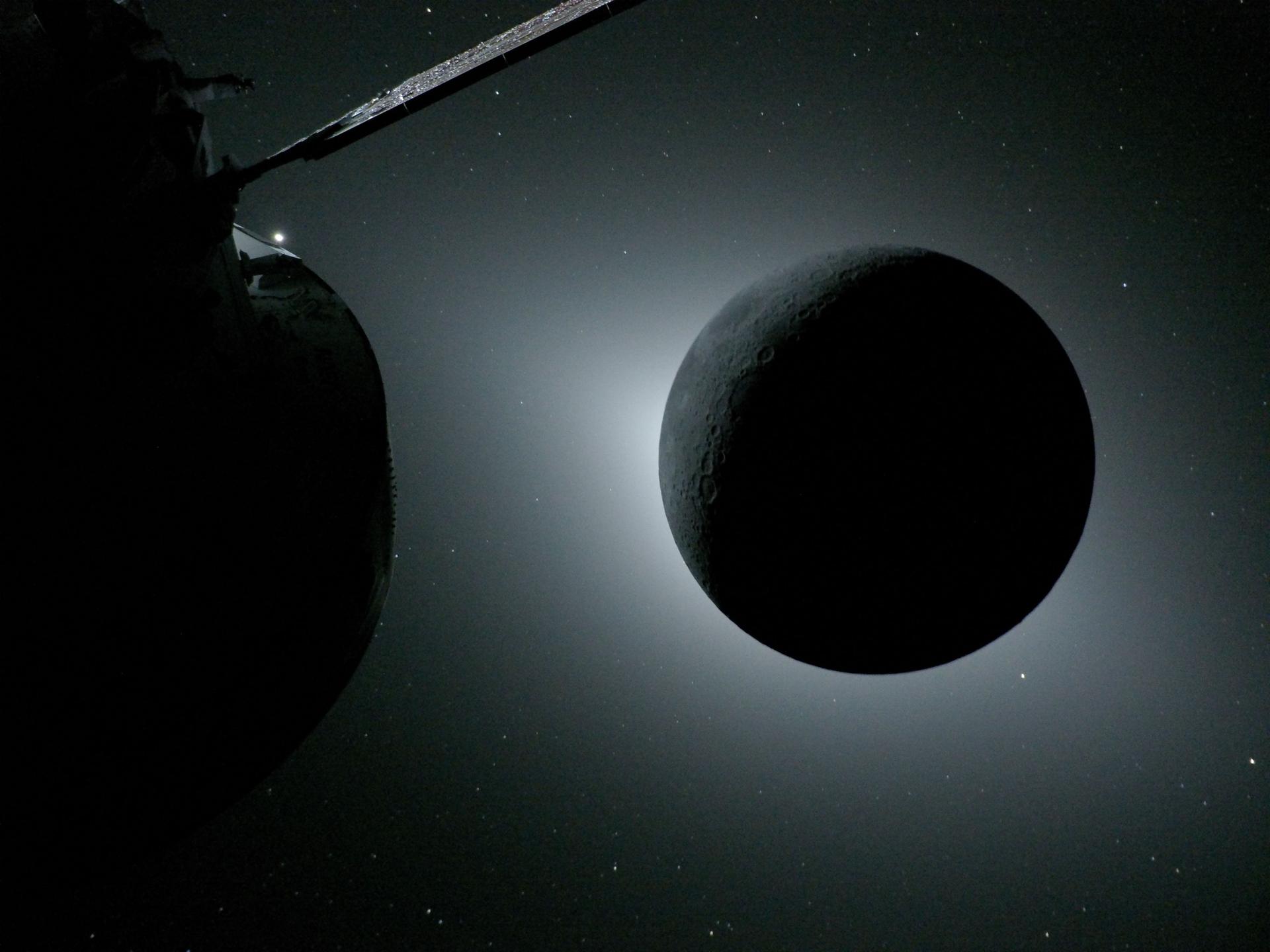
Hi everyone! I wanted to share a couple of cool Artemis photos that NASA has posted since I feel like we haven't talked about it too much in class yet.
1. The Moon during the solar eclipse the astronauts observed:
2. The surface of the Moon:
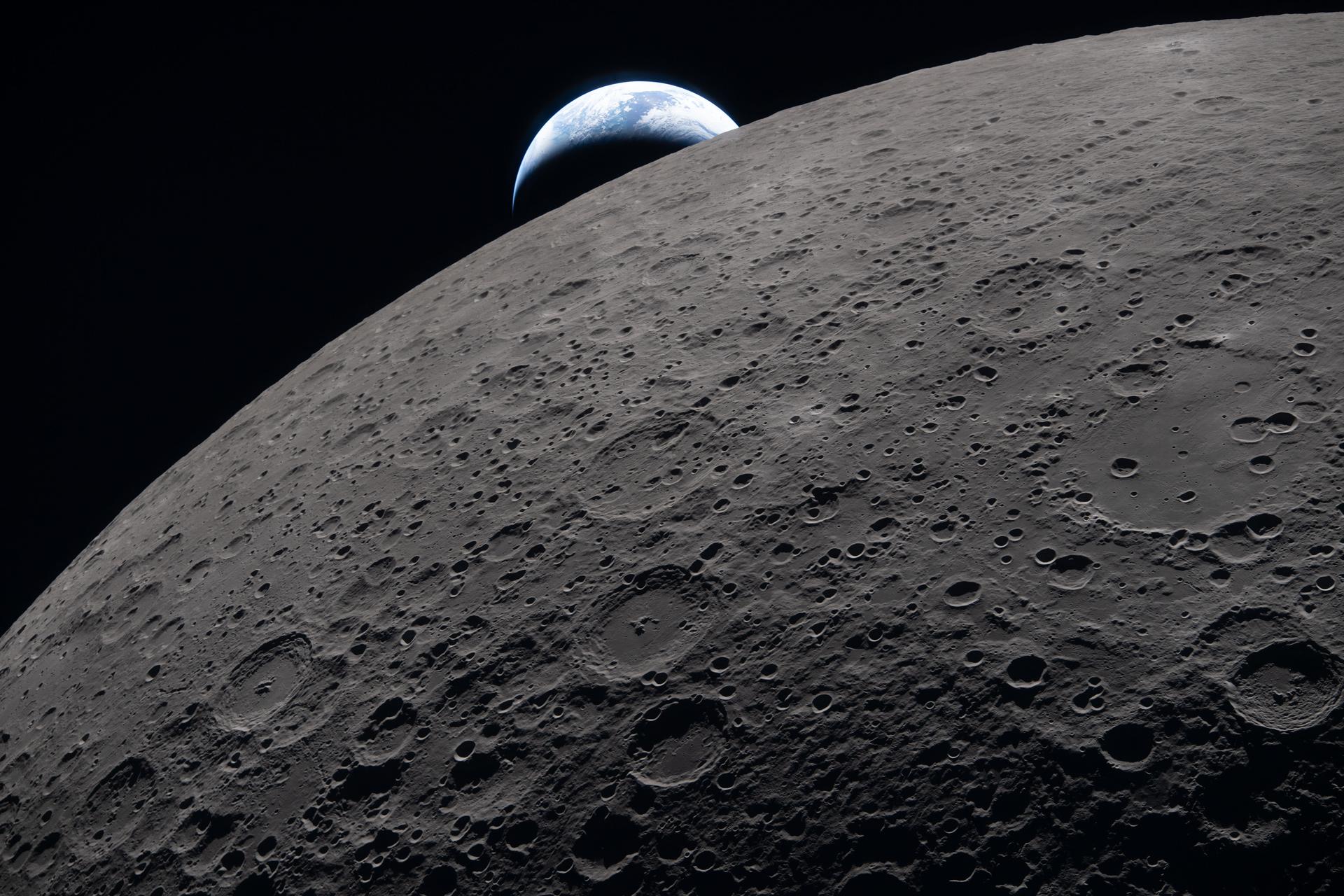
Here's a link to more photos:
Hopefully this HTML works!
Blog Post #180. Thu Apr 9 11:43:56 2026. Debika Biswas wrote:
While I found this section interesting, it was a bit harder to digest. I have a most likely simple question about cosmic spherules. The textbook mentions that they are fully melted. What does this mean, and are they liquid? Additionally, seeing all the interesting pictures in the book were cool! Lastly, I was hoping we could further discuss equations 11.1 and 11.2 on page 296 of the textbook.
Blog Post #179. Thu Apr 9 10:11:12 2026. Xuge Wang wrote:
Triton has geysers of liquid nitrogen. How does this compare to the water geysers on Enceladus? What does Triton's activity suggest about its origin?
Blog Post #178. Wed Apr 8 00:45:11 2026. Jasmin Mohammadi wrote:
I had a bit of hard time understanding this chapter - it just felt a bit denser to me. I had a quick question about the Yarkovsky effect and Poynting-Robertson drag. I know they both do the same thing of moving meteoroids to vicinities of resonances so they can cross the Earth's orbit but what mechanism specifically is causing this movement? Also, what exactly are resonances?
Blog Post #177. Tue Apr 7 15:20:50 2026. Caroline Wilking wrote:
Responding to Joseph's question, I found this article: https://www.nature.com/articles/ngeo698 which explores the distribution of lakes on Titan and suggests it could be due to asymmetric seasons on Titan resulting from eccentricity in Saturn's orbit.
Blog Post #176. Tue Apr 7 15:10:43 2026. Yixuan Peng wrote:
Typically, what features of the planet and the moon/satellite, can determine if the planet will be able to use tidal forces, etc. to reshape the moon/satellite?
Blog Post #175. Tue Apr 7 15:09:30 2026. Debika Biswas wrote:
I liked the reading for this class, as it's really interesting to see how much we know about particularly Saturn's satellites. Also how much they differ is interesting to think about. I however don't think I understand fully what causes the tiger stripes on Enceladus.
Blog Post #174. Tue Apr 7 15:07:33 2026. Oliver O'Brien wrote:
I was super excited to read about Titan (my favorite moon)! I did a research project over the summer reproducing Titan's atmosphere and studying potential chemical reactions in its lakes, so it's near and dear to me. I didn't know it had Xanadu mountains! Does anyone know why its winds are due East instead of West?
More generally, is there a reason that Saturn's moons tend to be icier than Jupiter's? Is this just because of there being more volatiles available in that region of the solar system? I was also curious about Dione's variations in surface alebdo. Does anyone know what they're from? Finally, does anyone understand what the textbook means by Janus (this website reference!) and Epimetheus sharing orbits and changing places every 4 years? I've never heard of that before!
Blog Post #173. Tue Apr 7 15:04:18 2026. Joseph Kleinman wrote:
Why does Titan have so many lakes in the north, but comparatively few in the south?
Blog Post #172. Tue Apr 7 14:16:07 2026. Jack Danser-Anger wrote:
This section of the book was very thought provoking for me. I'm sure this is not an original thought but reading about Titan made me think about whether its possible/has been observed to have a smaller satellite orbiting the satellite of a planet? Would the smaller one just get stuck in the orbit of the larger planet? Also I know we talked about Enceladus on Thursday, but what causes only portions of the surface to be lightly cratered, where other parts show billions of years worth of cratering? Just the geyser locations?
Blog Post #171. Tue Apr 7 12:40:58 2026. Shane Levay wrote:
I remember in one of my previous astronomy classes, I learned about Titan and the idea that it might support a form of life based on hydrocarbons rather than water. If surface life exists or could exist on Titan, how might its biochemistry, metabolism, and survival strategies differ from those of Earth-based life?
Blog Post #170. Tue Apr 7 12:31:32 2026. Thomas Kenna wrote:
I found this chapter to be really cool as I had no idea about how diverse moons can be! I would like a greater explanation/clarification on the Moon system on Saturn as I found that part of the textbook to be a bit confusing.
Blog Post #169. Tue Apr 7 12:02:24 2026. Zya Woodfork wrote:
Why did we expect Titan's winds to blow west? Do we know why they don't follow this expectation?
Blog Post #168. Tue Apr 7 11:32:24 2026. Ava Allen wrote:
I know we have plans to visit Jupiter and Saturn's moons (Europa clipper, dragonfly), but is there any groups trying to suggest visiting Uranus or Neptune's moons? Obviously they are much further and harder to reach, but we have barely observed them and even a flyby could tell us so much.
Blog Post #167. Tue Apr 7 10:26:19 2026. Xuge Wang wrote:
Europa and Enceladus both seem to have subsurface liquid water. Which one is the better candidate for extraterrestrial life?
Blog Post #166. Tue Apr 7 01:41:11 2026. Jasmin Mohammadi wrote:
Super quick question regarding the relationship between satellite surfaces and their proximity to the planet! The book states that surfaces of large, regular moons closest to the planet are typically younger with endogenic activity. Is this because the tidal force on these satellites are stonger?
Blog Post #165. Thu Apr 2 19:08:45 2026. Evelynn McNeil wrote:
I just finished the chapter on Venus, and I'm curious about the "catastrophic resurfacing events" in which the entire crust subducts. How would this happen? I am having difficulty picturing a lithosphere-wide overturning process without any clear subduction zones.
Blog Post #164. Thu Apr 2 15:38:57 2026. Evelynn McNeil wrote:
Komatiites are rocks produced by extremely ultramafic, extrusive eruptions of lava. Ultramafic means that they have very high magnesium and iron compositions, and low fractions of silicon. In this case, much lower silicon content than most extrusive eruptions on Earth. They typically contain the mineral olivine
Another important thing about Komatiite is that it has a very high melting point of 1600*C, which is higher than the melting temperatures reached in the Earth's lithosphere during modern day eruptions. Because of this, Komatiites are extremely rare on Earth and are often dated back to upwards of 4 Ga when the Earth was much hotter during its formative years.
Io experiences such extreme tidal heating from Jupiter that Komatiites are commonly and frequently erupted by its volcanoes.
Blog Post #163. Thu Apr 2 15:26:54 2026. Yixuan Peng wrote:
Interesting comparision of the two satellite systems just inside and outside of the asteroid belt. Mars has lower mass (thus lower tidal force) but also smaller moons, how come it is unable to geologially reshape the moons?
Blog Post #162. Thu Apr 2 15:26:27 2026. Zya Woodfork wrote:
If we know that Europa must contain some liquid water because of how Jupiter's magnetic field behaves around the moon, does that mean that the ocean must be a brine like we've talked about before?
Blog Post #161. Thu Apr 2 15:20:52 2026. Debika Biswas wrote:
Hi all! Learning about various planetary satellites for this reading was interesting. I didn't know much about Mars' moons so learning about them was cool. Additionally learning a more thorough reasoning behind Io and its volcanic activity was interesting and to see it in comparison to Earth's and Venus' volcanic activity.
Blog Post #160. Thu Apr 2 15:16:41 2026. Thomas Kenna wrote:
What stood out to me the most in 10.2 was the diversity of Jupiter's moons as they all seemed very unique from one another however the textbook didn't really explain why. I would assume their orbital distances would be a key factor as this changes the amount of tidal heating each moon receives but I'd wouldn't mind a greater explanation.
Blog Post #159. Thu Apr 2 15:05:01 2026. Ava Allen wrote:
Hi everyone!
I particularly enjoyed todays reading as I hope to research Planetary Satellites for my career! I was curious though why none of the Galilean satellites have a substantial atmosphere, while Saturn's moon Titan does? Could this be an effect of Jupiter's harsh magnetic field?
Blog Post #158. Thu Apr 2 14:30:56 2026. Oliver O'Brien wrote:
Hi everyone! After reading 10.1 and 10.2, I thought it was really interesting that Phobos is so heavily cratered and Deimos isn't when it's orbiting farther from Mars.
Also, reading about Io, I didn't realize it was capable of hosting ice on its surface! Do any other solar system bodies have SO2 ice on their surfaces? I don't know much about the molecule, but I know it can be indicative of volcanism on terrestrial bodies. In addition, I didn't know that Io's core took up such a substantial part of its volume!
This might be a silly question, but would it be reasonable to assume that Europa's "ice plates" act similarly to tectonic plates on Earth? In this case, the water sludge could be substituted for lava on the surface/magma below. Lastly, I didn't realize Europa had O, Na, and K in its atmosphere! It's strange to think of sodium and potassium as atmospheric gases, but I think they're trace gases in Earth's atmosphere too.
Blog Post #157. Thu Apr 2 11:57:06 2026. Gillian La Vina wrote:
Reading about Jupiter’s moons, I find it cool how volcanism on Io is formed via violent tidal forces releasing massive amounts of energy. Similarly, it’s also interesting how tidal forces from Jupiter maintain the liquid ocean on Europa. Overall, the moons of Jupiter are a lot more diverse and exciting than expected, and it is interesting to see how Jupiter’s presence effects these bodies.
Blog Post #156. Thu Apr 2 00:53:20 2026. Jasmin Mohammadi wrote:
To answer Caroline's question - I believe komatiite is a type of ultramafic (igneous/meta-igneous rocks with low silica content) volcanic rock, typically made of magnesium oxide.
Blog Post #155. Wed Apr 1 11:21:10 2026. Caroline Wilking wrote:
I am curious to know more about ultramafic magma volcanism on Io. What is a komatiite?
Blog Post #154. Tue Mar 31 15:27:44 2026. Joseph Kleinman wrote:
Going off of what we've done in another geology course, do you personally subscribe to the wet or dry Venus theory? That is, do you believe Venus was ever earth-like and habitable?
Blog Post #153. Tue Mar 31 15:07:29 2026. Debika Biswas wrote:
I found the reading to be very interesting! Learning about the similarities and differences between Venus, Mars, and Earth was nice. In particular, learning about erosion on Venus and how the atmosphere only allows for a little wind was interesting. Also the ice reservoirs on Mars was cool to learn about.
Blog Post #152. Tue Mar 31 14:43:52 2026. Caroline Wilking wrote:
I was surprised to learn Mars has 4 large shield volcanoes. Before, I had only heard about the largest, Olympus Mons.
One question I had about Venus was what does a catastrophic resurfacing event entail, exactly?
Blog Post #151. Tue Mar 31 11:55:48 2026. Oliver O'Brien wrote:
I thought it was interesting that the textbook says that Venetian rocks aren't as smooth as they should be. I also was a bit confused about how wind speeds are low on Venus but they can still transport a decent amount of sediment because of Venus' dense atmosphere. How does the amount of sediment wind can pick up relate to surface pressure/atmosphere density? Also, does anyone know more about the catastrophic resurfacing events that Venus may experience every few hundred million years? Would we be able to witness one if it occurred?
For Mars, why does the planet have so much more rust/iron than other terrestrial planets? How did Valles Marineris form? I'm also a little confused about how Mars is thought to have a fluid core but not a strong magnetic field. Is it not rotating quickly enough?
Blog Post #150. Tue Mar 31 11:41:44 2026. Ava Allen wrote:
Hi everyone!
I was surprised to read that Mars has more intrinsic magnetic behavior than Venus, as my understanding was that planetary cooling (which impacts if there is a fluid layer) was proportional to planet size. How did Venus's interior lose this heat generated behavior faster than the much smaller Mars did?
Blog Post #149. Tue Mar 31 02:19:46 2026. Jasmin Mohammadi wrote:
To answer @Zya's question on March 26th, I believe there it technically some effect on earthquakes due to the Moon pulling on the Earth but I think this is inconsequental with respect to the other factors that we do not really consider it. Forces are equal and opposite so I would assume it goes both ways, just not as strong due to the differing characteristics of the Earth.
Blog Post #148. Thu Mar 26 22:12:26 2026. Evelynn McNeil wrote:
*and these would
"and would thus" is misleading and does not follow
Blog Post #147. Thu Mar 26 22:10:37 2026. Evelynn McNeil wrote:
Addressing Joseph's question, I think there is a good case to be made for the Earth's larger gravitational influence affecting the frequency of LHB impacts on the moon. Because the Earth-moon system is more massive than Mercury, and its influence is spread out over a larger distance (the moon's orbit) it would make sense that larger asteroids would more frequently strike the Earth and Moon.
Additionally, Mercury's hill sphere (the region where its gravitational influence dominates and where it can attract asteroids) is further weakened by its proximity to the Sun. Being the first planet also decreases the frequency of LHB impacts, because the impactors coming from the outer solar system would have to evade 7 other, more massive planets first.
As to your question about the Mare, this could potentially play a role in why the crust is thinner on the Moon than on Mercury, but we also have to consider the concentration of the Mare on the near side. I have a personal impactor-related theory to this, and it also has to do with Earth's gravitational influence: Impactors pulled towards the Earth moon-system that hit the far side will have less energy (and penetration power) than those that first pass by Earth and are accelerated via the oberth effect, and would thus always strike the Moon's near side.
Blog Post #146. Thu Mar 26 15:11:56 2026. Joseph Kleinman wrote:
Is it possible Earth’s gravity caused larger meteorites to strike the moon, which led to it having Maria while similar Mercury, without a strong gravity well nearby, didn’t?
Blog Post #145. Thu Mar 26 15:08:23 2026. Zya Woodfork wrote:
Section 9.1 said that moonquakes can be a result of tides caused by the Earth's gravity. Are Earthquakes ever caused by the moon's gravity?
Blog Post #144. Thu Mar 26 15:05:32 2026. Debika Biswas wrote:
I really enjoyed this section and found the similarities between Mercury and the Moon really interesting. Also the contrast between the highlands and maria are cool! The reading addresses how we know that the moon has a liquid core, similar to Earth. It also talks about how seismic waves take a while to dampen on the Moon due to a lack of water or volatiles. I was wondering about the comparison of how seismic waves traveling through substances like water/volatiles and liquid metal differ.
Blog Post #143. Thu Mar 26 15:05:07 2026. Shane Levay wrote:
My takeaway from these two sections on the chapter was that despite the moon and Mercury looking simple and cratered, they are old, nearly airless, and show evidence of deeper evolution. I do have one question: If Earth's tides are a major cause of moonquakes, why do moonquakes occur both deep inside the moon and near the surface rather than just in one region? Does this suggest something about the moon's interior structure and or how stresses are transmitted?
Blog Post #142. Thu Mar 26 14:54:53 2026. Oliver O'Brien wrote:
After reading sections 9.1 and 9.2, I thought it was really interesting that the lunar highlands and the maria have fairly similar albedos (0.11-0.18 for the highlands and 0.07-0.1 for the maria) even though they appear different visually. I also didn't know that the South Pole Aitken Basin is the deepest impact basin in the Solar System! I would have thought it would be a crater on Mars for some reason. Additionally, I didn't realize the Moon still had a liquid core. I would have thought it would be fully solid by now.
Blog Post #141. Thu Mar 26 14:52:11 2026. Yixuan Peng wrote:
reference 9.1.2, so we can actually say the moon has a atmosphere ꉂ (≧ヮ≦).
for moonquakes, as known tidal force is limited in magnitude and sort of in a continuous state. in detail, how do tides from Earth cause a moonquake?
for mercury, its surface temperature vary within a large range, from below 100K up to 700K, but with a high density and high solid core portion. seems like it is physically stable under such temperature changes (e.g. thermo expansion).
Blog Post #140. Thu Mar 26 14:46:15 2026. Thomas Kenna wrote:
In 9.1 and 9.2 I found the similarities between the Moon's and Mercury's history of bombardment and volcanic activity very interesting. In addition, I really liked the theory of why Mercury has such a high iron percentage however I wondered about two things: what happened to the parts of mercury that were ejected? and since earth is also theorized to have been in a big collision which created the moon, how does it still have a 'typical' iron percentage? I would think that due to Mercury's proximity to the sun that most of the debris fell into the Sun and this was one of the ideas supported online. However, there were also suggestions that solar winds had swept away alot of the debris aswell. As for Earth, some online sources suggested the collision was not as catastrophic and I would assume this allowed the debris to be re-captured by the Earth and the material from the body that collided with the Earth remained in the Earth-moon system therefore keeping Earth's iron percentage fairly normal.
Blog Post #139. Thu Mar 26 13:20:50 2026. Evan Shipley-Friedt wrote:
Do variations in the Moon’s gravitational field (mascons) significantly affect short-duration missions like Apollo 13, or are their effects only important over long orbital timescales?
Blog Post #138. Thu Mar 26 13:10:49 2026. Gillian La Vina wrote:
I did not know about Mercury’s rupes caused by contraction due to cooling, and that Mercury’s radius has decreased by about 4 km over time. Do the other planets contract over time as their internal heat cools? If so, do other planets show similar signs or geological features due to contraction?
Also, does the offset of the Moon's CM have anything to do with Earth's presence, given it is in the direction of Earth's CM?
Blog Post #137. Thu Mar 26 10:16:44 2026. Xuge Wang wrote:
Can you elaborate more on the gravity distribution on the Moon? How does it relate to the Crustal Thickness? I don't think the mass difference is enough to be convincing.
Blog Post #136. Wed Mar 25 21:23:59 2026. Jasmin Mohammadi wrote:
I really enjoyed reading this chapter! Maybe it was because of the studying that came with the first midterm but this chapter felt like everything was very clear and I understood the logic behind the features of the Moon and Mercury. It felt like all of these class content thus far came together here. I especially liked reading about the history of these planets and how we can determine the ages of them through their surface structure. I was curious and looked into how KREEP chemical composition formed on the Moon because I was a bit confused on where these rare Earth elements came from - it comes from early lunar magmatic differentation.
Blog Post #135. Wed Mar 25 20:52:30 2026. Ava Allen wrote:
Hi everyone!
Todays readings were very familiar for me as I am currently taking Lunar Geophysics and Geology of Terrestrial Planets! Before spring break I actually gave a presentation about the Apollo moonquake data discussed in Chapter 9.1. They specifically looked at 4 wave refractions, which they modeled at different depths in order to constrain the Moon’s interior structure.
Blog Post #134. Tue Mar 24 15:10:44 2026. Jonah George wrote:
What causes the difference in the magnetic field axis and the rotation axis in planets, and the displacement from the center? Since the magnetic fields are caused by conductive liquid materials in the cores of planets, I would assume that the field axis is going to be quite centered on the planet, since the planets are spherically symmetric on larger scales.
Blog Post #133. Tue Mar 24 15:09:56 2026. Shane Levay wrote:
Why would two planets with similar bulk compositions still end up with visibly different atmospheres and magnetic geometries?
Blog Post #132. Tue Mar 24 14:54:39 2026. Jonah George wrote:
What causes the shape of the wind velocity curve for Uranus and Neptune, shown in Fig. 8.24? Why is there a dip near the equator, and why does the max speed on Neptune seem to be greater than on Uranus?
Blog Post #131. Tue Mar 24 12:03:01 2026. Yixuan Peng wrote:
reference post 130. I think for now we still do not have ability to actually observe the surface below atmosphere of the giant planets, but able to observe the cloud layers. For Jupiter, figure 8.10 provided a illustration of a impact. Since atmosphere on Jupiter is very dense, the turbulance would cause a plume to appear (rise and collapse) which is thus observable. In addition, agreed on high wind velocity of Jupiter atmosphere. The timescale was in minutes. It seems larger objects may last longer, but certainly much shorter than impact on solid surfaces.
Blog Post #130. Wed Mar 18 19:54:52 2026. Xuge Wang wrote:
According to the textbook, "our knowledge of the cloud layers on Jupiter, as well as on the other giant planets, is therefore largely theoretical", then how could we interpret the size of the impactor based on the observation of the gas craters on those planets, at the same time, I assume that the windspeed on those planets are high enough to modify the craters quickly.
Blog Post #129. Wed Mar 18 15:30:53 2026. Evelynn McNeil wrote:
What exactly is Io's neutral cloud? The textbook says that this is a "cloud" composed of oxygen and sulfur created by accelerated "corotating" ions interacting with the Ionian atmosphere and creating netural oxygen (O2?) and sulfur (H2S, SO2?) compounds. Is this an atmospheric layer of Io? A single airmass over part of the moon? A torus structure that surrounds Jupiter like the plasma it creates?
Also, what is meant by corotating? Does this refer to ions orbiting Jupiter in the same direction as its magnetic field lines?
Blog Post #128. Tue Mar 10 15:17:49 2026. Joseph Kleinman wrote:
I heard once that Neptune’s great dark spot is more like a hole into the deeper layers of the planet, and then an actual storm. Was there any truth to this statement?
Blog Post #127. Tue Mar 10 15:05:33 2026. Zya Woodfork wrote:
Why is the vortex at Saturn's north pole hexagonal while the south pole's vortex is more curved? And what caused this storm to have such defined straight edges? Have we observed storms like that anywhere else?
Blog Post #126. Tue Mar 10 14:55:59 2026. Caroline Wilking wrote:
I was surprised to learn that Neptune no longer has a Great Dark Spot! I remember learning about it a long time ago and had assumed it was a permanent feature. It’s very interesting to me how things like this can change over time.
Blog Post #125. Tue Mar 10 13:58:04 2026. Gillian La Vina wrote:
After reading the section on Uranus and Neptune, I find it interesting how the interiors of intermediate planets are more mysterious compared to low density, large radii planets like Saturn and Jupiter. It's cool how the current constraints allow for a lot more possibilities in terms bulk composition as well as segregation and layering for Uranus and Neptune. I wonder what future measurements we can take to help constrain our current models. Could unexpected results even alter our current version of the history of the solar system?
Blog Post #124. Tue Mar 10 13:56:22 2026. Meghan McKenna wrote:
In the section of interior structure for Saturn. How is helium sedimentation able to happen on Saturn, how long does this process take? How will this eventually effect Saturn, if we aren't seeing the effects already?
Blog Post #123. Tue Mar 10 13:49:43 2026. Jack Danser-Anger wrote:
I found this group of readings to be very interesting. In general, understanding magnetospheres and radio emissions is generally difficult for me. I am curious what causes the hexagonal storm on the north pole of Saturn? Not sure if its related but it kind of reminded me of the image of the polar vortices on Jupiter's poles where there were 8 swirling storms that had some level of radial symmetry.
Regarding Neptune and Uranus, I find it interesting how vastly different they are from all of the other planets, but how similar they are to each other, so much so that they are often just discussed together. What is the reason for this? Also what causes the magnetic axis to be so far displaced from the spin axis, both in angle and linear distance, with respect to the spin axis?
Blog Post #122. Tue Mar 10 13:25:33 2026. Evan Shipley-Friedt wrote:
In PHYS 404 (Thermal Physics) we derived the multiplicity and entropy for a monatomic ideal gas using the Sackur–Tetrode equation. This assumes particles behave like a non-interacting ideal gas. However, in the deep interiors of Jupiter and Saturn the conditions are very different. At extremely high pressures hydrogen becomes metallic and helium can become immiscible in the hydrogen fluid, leading to helium rain. Since the matter is no longer behaving like an ideal gas and particle interactions become very important, the Sackur–Tetrode entropy equation would no longer be valid. Instead planetary interior models must use more realistic equations of state that include strong interactions and phase separation between hydrogen and helium.
What thermodynamic model or equation of state replaces the Sackur–Tetrode ideal gas entropy when modeling helium rain in giant planet interiors?
Blog Post #121. Tue Mar 10 13:12:34 2026. Thomas Kenna wrote:
I found 8.2 and 8.3 to both be quite enjoyable readings. In particular, I thought it was interesting that Saturn likely has a larger core than Jupiter. while the textbook didn't explicity state why I believe it's because saturn has heavier elements and weaker gravity which causes less compression of the core. In addition, Saturn's hexagonal vortex will always be super cool and i wish the textbook went into more depth about why it's shaped that way. As for Uranus and Neptune, i was really surprised by how similar they were especially their internal structures. I also really liked the discussion on the methods and thought-processes used to make predictions about a planets structure.
Blog Post #120. Tue Mar 10 12:56:15 2026. Evan Shipley-Friedt wrote:
To answer Oliver’s question 4:
Saturn appears to have a higher relative abundance of methane compared to Jupiter because the heavier elements (like carbon) are more enriched in Saturn’s atmosphere relative to hydrogen and helium. Jupiter and Saturn both formed mostly from hydrogen and helium gas, but Saturn likely accreted a larger fraction of icy planetesimals containing carbon compounds during formation. Methane is the primary carbon-bearing molecule in the cold atmospheres of giant planets, so this enrichment shows up as more methane in Saturn’s atmosphere. This difference is one of the reasons Saturn appears slightly more yellowish and why methane becomes even more dominant in the colder atmospheres of Uranus and Neptune.
Blog Post #119. Tue Mar 10 11:30:56 2026. Oliver O'Brien wrote:
After reading 8.3, I didn't realize Uranus and Neptune had such constant weather! It never occurred to me that these planets likely wouldn't have as many clouds when they're farther from the Sun. I also thought it was interesting that Neptune might have elevated abundances of CO and HCN because of a recent cometary impact. Would something similar have happened after the Shoemaker-Levy 9 impacts on Jupiter? Third, I was curious about Uranus's lack of a heat source aside from radioactive heating. Could this be from the impact that caused it to flip sideways? Finally, why do Uranus and especially Neptune have such significant differences between their rotation axes and magnetic field axes? What impacts do their magnetic centers being displaced from their physical centers have on their structure?
Blog Post #118. Tue Mar 10 11:08:30 2026. Debika Biswas wrote:
Hi! I had a question about the depletion of He in Saturn's atmosphere. The textbook talks about how the He, since heavier than H, sinks to the bottom of the envelope. How does this make it difficult to detect as I am pretty sure we can still detect things further into the atmosphere. Also why do the other gas giants not show this trait?
Blog Post #117. Mon Mar 9 23:21:38 2026. Xuge Wang wrote:
During the revision stage for Chapter 6, I got two questions:
The text mentions that details of the peak ring formation are not completely understood—what are some current hypotheses or ongoing research in this area?
What observational techniques or missions (e.g., from spacecraft) have provided evidence for the rebound and collapse stages described?
Blog Post #116. Mon Mar 9 18:10:53 2026. Ava Allen wrote:
Hi everyone!
After reading about the differences between Uranus and Neptune, compared to Jupiter and Saturn, I found myself thinking about theories of giant planet migration. I know there are models of the giant planets moving around during the formation of the Solar System, since Uranus and Neptune are more ice, do we assume that they were not involved in any migration? Is it possible they formed warmer and gathered the ice later?
Blog Post #115. Sun Mar 8 15:58:58 2026. Jasmin Mohammadi wrote:
After reading about the magnetic fields on Neptune, I was a bit confused in understanding how they changed based on the alignment of the rotational and magnetic axes. Specifically, I am struggling to understand how the magnetic field changes when the magnetic pole is pointed directly towards the Sun. I know it changes because of the solar winds flowing into the planet's polar cusp, but I am a bit confused on what this new configuration looks like and what it means for the planet.
Blog Post #114. Thu Mar 5 15:21:46 2026. Yixuan Peng wrote:
It is intersting to see Jupiter and Saturn shares such similarity, and quite different from Uranus and Neptune. Reference figure 8.4, by mere velocity graph, it seems like Jupiter has more than 6 hadley cells each on north/south?
also, a visual process of how Io's plasma torus works will be preferable. and what is the 'planetary wind' appeared in figure 8.15?
Blog Post #113. Thu Mar 5 15:10:18 2026. Zya Woodfork wrote:
I'm confused about the state of Jupiter's core. Is it actually solid or just really dense gas? If there is a solid core, is it possible that it has craters or any tectonic activity?
Blog Post #112. Thu Mar 5 14:33:18 2026. Oliver O'Brien wrote:
Today's readings were a good refresher on Jupiter and Saturn! I think it's crazy that we still don't fully understand the composition/behavior of the giant planets' atmospheres. I also didn't know that Jupiter's magnetosphere could extend as far as Saturn!
Here are my questions:
1. This is a bit more general, but are all planets contracting? Are any ever expanding?
2. What exactly is Io's neutral cloud? Is it part of its atmosphere? I feel like the textbook glossed over this a bit.
3. Are there parts of Saturn that are always in the shadow of its rings? I didn't realize that could affect its weather!
4. Why does Saturn have more methane than Jupiter?
5. How does distance from the Sun affect a planet's magnetosphere? I feel like I should know the answer to this question, but I honestly don't remember.
Blog Post #111. Thu Mar 5 14:21:34 2026. Jack Danser-Anger wrote:
I think its super cool that we were able to observe an impact on Jupiter.
I was wondering if you could talk about the neutral cloud of Io and what that is, as well as the plasma torus from Io. How does this affect Jupiter if at all?
Blog Post #110. Thu Mar 5 14:03:01 2026. Shane Levay wrote:
This chapter feels less equation-heavy and closer to more observational. My question so far for this chapter is Why does photochemistry drive Jupiter's upper atmosphere into chemical disequilibrium?
Blog Post #109. Thu Mar 5 14:02:01 2026. Joseph Kleinman wrote:
Sort of broad but what have the observations from Juno changed about the way we look at Jupiter?
Blog Post #108. Thu Mar 5 13:45:18 2026. Meghan McKenna wrote:
How does Jupiter's magnetotail affect Saturn?
Do the other Moons of Jupiter also interact with the magnetic field/tail?
What is the internal heat source of Jupiter and how do we know there's a solid core?
Blog Post #107. Thu Mar 5 13:38:58 2026. Caroline Wilking wrote:
Since this book was published, do we have any better ideas as to why the GRS and other storms are red on Jupiter?
Blog Post #106. Thu Mar 5 12:14:58 2026. Debika Biswas wrote:
Hi everyone! I had a few questions regarding 8.1. This is also related to what we talked about in class previously. The textbook talks about how on Jupiter, the areas with white clouds are generally colder. Is this due to the albedo and the white clouds are reflecting more sunlight than it is absorbing, or is it also due to the gases present in the white clouds, or both?
I also though 8.1.2 was really interesting in showing how we can tell if there is an impact even though Jupiter doesn't have a surface.
Blog Post #105. Thu Mar 5 12:14:16 2026. Gillian La Vina wrote:
After reading section 8.1 about Jupiter, I became interested in Jupiter's absurdly large magnetosphere. Do we know exactly why Jupiter's magnetic field spans so far? Do we derive Jupiter's internal composition based off its magnetosphere? What other kinds of properties can we currently derive about Jupiter thanks to direct magnetic field measurements?
Blog Post #104. Thu Mar 5 00:38:11 2026. Jasmin Mohammadi wrote:
After reading 8.1 I had a question regarding the storm systems - in the book it says that circulating clockwise in the northern hemisphere and counterclockwise in the southern hemisphere indicate high-pressure systems. What about the rotation shows that? Is this what we were discussing in class about the directionality of the pressure force?
Blog Post #103. Wed Mar 4 19:20:48 2026. Ava Allen wrote:
I know Jupiter doesn't have a surface, but is the heavy core solid at any point? Or is it all molten since Jupiter has so much internal heat? If I could resist 1000s of Kelvins of heat and an enormous amount of pressure from Jupiters gaseous layers, is there a solid surface on a core to stand on?
Blog Post #102. Tue Mar 3 16:48:01 2026. Meghan McKenna wrote:
How does the strata above become flipped over?
Blog Post #101. Tue Mar 3 15:25:15 2026. Jonah George wrote:
6.4 was interesting to me because of how it described the formation of primary craters and corresponding jets, secondary craters, etc. One question I had was: how do rays form? Personally, I would expect the ejecta to be distributed more "uniformly" from the impact point--does it depend on the energy of the impact? Are there special directions relative to the projected impact angle where rays are more likely to form?
Blog Post #100. Tue Mar 3 15:12:04 2026. Zya Woodfork wrote:
We can use the number and condition of craters on an object's surface to determine if or how long it has been since it was last geologically active. What's the furthest distance an object can be where we can detect and study these features on its surface?
Blog Post #99. Tue Mar 3 14:57:13 2026. Debika Biswas wrote:
6.4 was really interesting to me, as I didn't know that there was so much to learn about in regards to craters. I found the section on the stages of crater formation really interesting. I also thought it was cool that you can tell a lot about an impact from the crater itself and how much energy it causes.
Blog Post #98. Tue Mar 3 14:51:20 2026. Meghan McKenna wrote:
Just to clarify the impact crater depends on the density, composition, speed, size of the object and vice versa with the impacting object. What characteristic has the largest impact on crater size?
I know that rarefaction waves develop behind the shock wave because free surfaces cannot sustain stress. Which direction does the shock wave go and what is it comparable to?
Blog Post #97. Tue Mar 3 14:26:36 2026. Joseph Kleinman wrote:
Both Mercury and the Moon have similar sizes and compositions (as far as I know) yet Mercury lacks the mara that dominate the surface of the Moon. What could have potentially caused this discrepancy?
Blog Post #96. Tue Mar 3 14:14:36 2026. Shane Levay wrote:
I was able to fully digest the chapter after rereading it, but I still have a few questions. If a planet experiences periodic global volcanic resurfacing events, how would its crater density curve evolve over time? Would the age–crater relationship be linear?
Blog Post #95. Tue Mar 3 13:48:50 2026. Jack Danser-Anger wrote:
Section 6.4 was really interesting to read about. I found it super interesting to read about how the central peak and peak rings can form and I find it crazy to think about impacts of that magnitude. I did not really understand where the "rays" shooting out from the primary impact on the moon come from. I remember reading that they are comprised of secondary ejecta and imacts, but what constrains them to travel in a more or less linear path like that?
Blog Post #94. Tue Mar 3 12:26:12 2026. Oliver O'Brien wrote:
Hi everyone! I asked a bunch of questions about today's reading, so today I'm going to try to answer other folks' questions!
@Jasmin's question about free surfaces: I think a free surface can be thought of as essentially regolith, so the loose sediment on the surface of a body. In this case, I think it would be the rock/ice layer that an impactor makes contact with.
@Ava's question about crater counting on icy moons: I'm not fully sure, but I think since craters form differently on ice vs. rock, you might have to employ different strategies to use crater counting efficiently. I also think that unfortunately, this method (if it's possible to do in the first place) would only give you the age of the oldest ices, which don't correspond to the age of the body itself.
@Debika's question about craters changing tectonic activity: I think theoretically, you could have a crater extend to the tectonic plates, but at that point, I'm assuming the planet is being destroyed because the tectonic plates are pretty far (distance-wise not scale-wise if this makes sense) below the surface. For reference, the Chicxulub impactor initially created a 30-km deep crater, and tectonic plates are closer to ~100 km below the surface of the Earth, so for an impactor to create a crater that deep, it would be absolutely enormous.
I hope this was useful!
Blog Post #93. Tue Mar 3 12:14:22 2026. Yixuan Peng wrote:
reference #91. i will assume you are referring to micrometeroroids, since micrometeorite is defined to be micrometeroroid that has survived atmosphere entering process (wikipedia). wording is interesting. upon entry, it will largely depend on composition of the meteroroid, which if they burn up/decomposes under high temperature. and reference textbook, i found "The smallest meteoroids to hit the Earth’s atmosphere are slowed to benign speeds by gas drag or vaporized before they hit the ground". it seems they do not really 'hit', but released energy to leave a crater. In addition, entry angle also does matter.
Blog Post #92. Mon Mar 2 18:08:25 2026. Jasmin Mohammadi wrote:
To answer @Zya's second question! I believe the reason we knew the Chicxulub crater was the dinosaur killer was due to sampling of the material that composes the crater and by determining the age of the uprooted boundary (it matched that of the era that the dinosaurs were killed in). The reason we still see it, then, is because of its massive size! This crater is about 200 km wide - getting rid of something this big would take a very long time to totally erase it.
Blog Post #91. Sun Mar 1 15:47:06 2026. Ava Allen wrote:
With regards to smaller impacts: do micrometeorites reach the surface of Earth? Obviously the smallest impacters are stopped by our atmosphere, but are medium-sized ones broken into micrometeorites like those that hit the Moon and Mercury?
Blog Post #90. Thu Feb 26 18:36:46 2026. Evelynn McNeil wrote:
I wanted to ask about the Coronae on Venus. The book claims that these are depressions created by the isostatic weight of lava flows over the Venusian surface. I was told by a professor in the geology department that these are rather extensional features unrelated to isostasy and likely have to do with mantle plume-lithosphere interaction. Which explanation is correct?
Blog Post #89. Thu Feb 26 15:20:03 2026. Zya Woodfork wrote:
This section was really interesting! A few questions I have are 1) Can we detect craters in other ways besides through visual observations? and 2) How did we determine the location of the impact that killed the dinosaurs when the Earth's surface is so active and always changing?
Blog Post #88. Thu Feb 26 15:18:20 2026. Yixuan Peng wrote:
reference chapter 6.4. It is a very informative section. for impace craters, how exactly does the multiring basins form? If it is one ring, it is likely resulted from excavation flow. figure 6.31 does a fine illustration, but this experiment is liquid. so it is the rarefaction waves? how much resemblance does solid/rocky planet/objects have to liquids?
Blog Post #87. Thu Feb 26 15:15:24 2026. Oliver O'Brien wrote:
Impacts are really cool! This is another topic we'll be covering in my geology class, so I'm excited to get a headstart on it today in class! I assumed there was a relationship between the size of the impactor and the size of the crater it produces, but it was interesting to learn the specific numbers/equations involved! I also had no idea just how much pressure surfaces can be compressed to in the contact and compression phase of an impact or that the excavation phase can take several minutes to occur depending on the crater size and the impacted object's gravity! Finally, I didn't know that the Moon's regolith can be meters deep and that it has areas of mega-regolith. I guess I've never really thought about it before!
Here are my questions (A lot this time!):
1. What exactly counts as a substantial atmosphere when we're determining whether an impactor will become a bolide?
2. Are there any well-known examples of a comet impacting a body in our Solar System (aside from Shoemaker-Levy 9)?
3. How do we identify microcraters if they're so small? Have we seen them on bodies other than the Moon? Have we ever witnessed a microcrater being formed?
4. When the textbook mentions that a "ring of mountains" can be formed around the central peak in a crater, what exactly does it mean by "mountains"? I'm assuming this isn't the type of mountains on Earth that this makes me think of.
5. Have complex craters with central pits been found on non-icy surfaces? The textbook implies that they haven't, but I wanted to double-check.
6. Are there any known examples of a chain of primary craters formed by an impactor being tidally disrupted by a planet and crashing into a moon?
Blog Post #86. Thu Feb 26 14:42:09 2026. Thomas Kenna wrote:
Although 6.4 was quite a long, I actually found it easier to read and understand than some of the previous sub chapters. The formation of rays stood out to me quite a bit and I had one question regarding them. Is there anything which is determining which directions the rays go or is it completely random?
Blog Post #85. Thu Feb 26 14:29:36 2026. Gillian La Vina wrote:
Reading 6.4, I enjoyed reading about the process of crater formation and found the diagrams in this chapter especially helpful. I imagine computer simulations would be very useful to study crater formation and structures, as the core physics and material principles seem to be well known, but the details would require a lot of calculation.
Blog Post #84. Thu Feb 26 12:59:28 2026. Joseph Kleinman wrote:
This chapter was probably my favorite due to how completely it went over the formation process of craters in a visual way. Is there a formula to calculate whether a meteor will hit the surface of a planet or get vaporized by the atmosphere?
Blog Post #83. Thu Feb 26 11:17:39 2026. Shane Levay wrote:
This chapter reminded me a lot of ASTR 220. Impact cratering and ejecta. During the early years of our solar system's life, there was a higher rate of impacts. How would these intense early bombardments influence things like crust formation and atmospheric evolution?
Blog Post #82. Thu Feb 26 10:56:47 2026. Debika Biswas wrote:
I had a few questions which 6.4 brought up for me. Given how deeply imbedded into our crust a grater can be, can it ever change tectonic plate activity? Can a crater create a valley so deep, that a chunk of tectonic plate gets displaced and moves differently then how they move right now? Another related question is if tectonic plates got created by convection in the mantle or did they break apart because of a different reason?
Blog Post #81. Wed Feb 25 17:24:26 2026. Ava Allen wrote:
Hi everyone!
While reading Chapter 6.4 the interesting crater history of icy moons in our Solar System stood out to me. I am curious how surface dating processes differ (from that of terrestrial worlds) since the subsurface liquid resurfaces these bodies differently (than terrestrial worlds). Particularly, when using crater counting on a surface with a subsurface ocean, do we have to use different models of expected number of impacts over time? Are we able to use the palimpsests to help date the surfaces, or do they not have clear time evolving behavior?
Blog Post #80. Wed Feb 25 16:25:36 2026. Jasmin Mohammadi wrote:
The section on impact cratering was super interesting! I did have a question regarding a term in the book - it states that rarefaction waves develop after shock waves because "free surfaces can't sustain the state of stress". What defines a free surface? Is this just the interaction with the first rock/ice layer it hits or does it come from the movement of the projectile through the air before it hits the target?
Blog Post #79. Tue Feb 24 15:41:35 2026. Evelynn McNeil wrote:
On page 130 in the textbook in 5.8.2 Climate evolution. The Passage states that "a decrease in a planet's albedo will lower its temperatures as more sunlight is reflected.."
This should say increase instead.
Blog Post #78. Tue Feb 24 15:38:42 2026. Evelynn McNeil wrote:
Blog Post #77. Tue Feb 24 15:06:52 2026. Yixuan Peng wrote:
chapter 6.3 has most content being intuitively reasonable. The discussion related to lava composition is interesting. It seems the existence of volcanic activity may as well serve as proof of existence of water (although may not sufficient of life supporting).
Blog Post #76. Tue Feb 24 14:53:30 2026. Oliver O'Brien wrote:
I thought Section 6.2 was interesting! I learned about the angle of repose and mass wasting in my geomorphology class last spring, so it was cool to read about these topics again! I also didn't realize that the remains of organisms act as a continuous source of magma for volcanoes formed at subduction zones (Pretty metal!). Finally, I didn't know that Venus and Titan both had dunes! I know aeolian processes are important on Mars' surface, but I was unaware of dunes existing on other bodies (aside from Earth)!
This isn't a super class-relevant question, but I was curious if anyone knew why we don't usually learn about other supercontinents or continental formations aside from Pangaea? Do we only know about Pangaea because it was the state of the world when some dinosaurs were alive?
I'm also curious if anyone could explain how resurgent calderas work a bit. Are these just weak areas of the crust where magma can repeatedly reach the surface?
Blog Post #75. Tue Feb 24 14:09:46 2026. Jack Danser-Anger wrote:
Overall I found this section of reading very interesting, learning more about volcanoes helped to answer some of my previous questions regarding a liquid magma with a solid rock mantle. I did have a quick point of clarifcation needed. The chapter mentioned 3 types of volcanism, "eruptions along the mid-oceanic ridges and in subduction zones" with the thrid being essentially the kind that forms islands. Does this third kind of volcanism contain the explosive and effusive types, or are those general to all three kinds of volcanism?
Blog Post #74. Tue Feb 24 14:05:19 2026. Joseph Kleinman wrote:
I know Mars and Venus have tectonics, but not plate tectonics specifically. If so, how could volcanoes form there? Did they form earlier when they did have plates, or do resurfacing events create these familiar shapes as well?
Blog Post #73. Tue Feb 24 12:52:29 2026. Shane Levay wrote:
This section felt more like a review of previous Astro classes. It was cool to think about how massive volcanoes like Olympus Mons formed from a localized mantle plume, since Mars lacks active plate tectonics. Why might plate tectonics be important for long-term planetary habitation?
Blog Post #72. Mon Feb 23 20:53:24 2026. Caroline Wilking wrote:
I found it interesting to learn all the different terms used to describe surface features in 6.3. I was surprised to learn that Pangea was not the first continental assemblage/breakup - I had assumed that the Earth started that way.
Blog Post #71. Mon Feb 23 18:29:12 2026. Debika Biswas wrote:
I found 6.3 to be a pretty interesting section, and I liked the content a lot. I've heard of the Richter magnitude scale before, but I didn't realize just how much energy is released by earthquakes. There was a lot to learn as well in the different categories such as different types of volcanic activity. For example I haven't really thought that much about it, but it is cool that geysers are a type of volcanic activity. It is also really interesting to see what we know about the surfaces of other planets.
Blog Post #70. Mon Feb 23 12:21:54 2026. Thomas Kenna wrote:
In 6.2 I thought the use of the ratio I/(MR^2) was a really cool and useful trick to be able to get an idea of the internal density distribution of planets.
In 6.3, I was really surprised about the importance of water in regard to plate tectonics as without it, rock would be too strong to break the lithosphere. In addition, why does Earth have oceanic and continental plates and why are they at different heights?
Blog Post #69. Sun Feb 22 17:58:16 2026. Jasmin Mohammadi wrote:
I was particularly interested in the volcanism section of chapter 6.3 and I did have a question regarding them - what kind of technology is available to predict volcanic activity and how can we measure it? I know often with seismic activity we track the way waves travel through the planet of interest. What mechanism do we use for volcanoes?
Blog Post #68. Sun Feb 22 13:35:07 2026. Ava Allen wrote:
After reading about angle of repose in chapter 6.3, and how it is affected by the gravity of the planet/body, I was wondering if this means that landslides are more common on Earth and Venus than the Moon or Mars?
Blog Post #67. Thu Feb 19 15:07:57 2026. Zya Woodfork wrote:
I learned a lot of new information from this section! Something that's still a little confusing to me is how polar wander works. How does a planet get to have a mass anomaly? And what does the time scale for a polar shift like this look like? Is this something that only happens to younger, recently formed planets, or can it happen to older ones?
Blog Post #66. Thu Feb 19 14:48:42 2026. Oliver O'Brien wrote:
I thought it was really interesting that when we discuss the density of planets and other large bodies, we're referring to the uncompressed density and not the actual density. This is actually something we discussed in my geology class earlier this week! How does this affect how we measure the densities of faraway objects, especially when we don't necessarily know what their interior structure looks like?
I also thought it was interesting that a body that isn't rotating has a stronger gravitational force at its surface than an equivalent body that is rotating. We got into this a bit on Homework 1, but reading this section helped me really internalize it.
Finally, I'm glad the textbook discussed at what size an object starts to become spherical! This is something I've been wondering about, especially in my geology class where we've also been discussing moments of inertia and how to find the density of differentiated objects.
To answer @Ava's question about tectonics on Venus, I think having plate tectonics would cool the planet significantly because it would allow the CO2 to be pulled out of the atmosphere and into rocks, greatly reducing the greenhouse effect. In fact, I wonder if Venus once had plate tectonics if it would have ever gotten as hot as it is now?
Blog Post #65. Thu Feb 19 14:31:24 2026. Yixuan Peng wrote:
reference textbook 6.2. equipotential surface does well explained why sealevel is alwaysed as reference. the discussion related to density of stars/planets is very interesting. this also relates to q2 is hw1. reference table E.15, the factor attached to moment of inertia differs a lot between Sun and Earth. herein it ought to be a indication of differ in internal density structure.
huge congrats to post #63 ദ്ദി ˉ͈̀꒳ˉ͈́ )✧
Blog Post #64. Thu Feb 19 14:22:58 2026. Gillian La Vina wrote:
I enjoyed reading about gravity fields. It feels refreshing to see physics equations after looking at a lot of chemical reactions when studying atmospheres. I am excited to use these new concepts to solve problems, I think it will be interesting to work with different kinds of mass distributions
Blog Post #63. Thu Feb 19 13:49:05 2026. Prof. Doug Hamilton wrote:
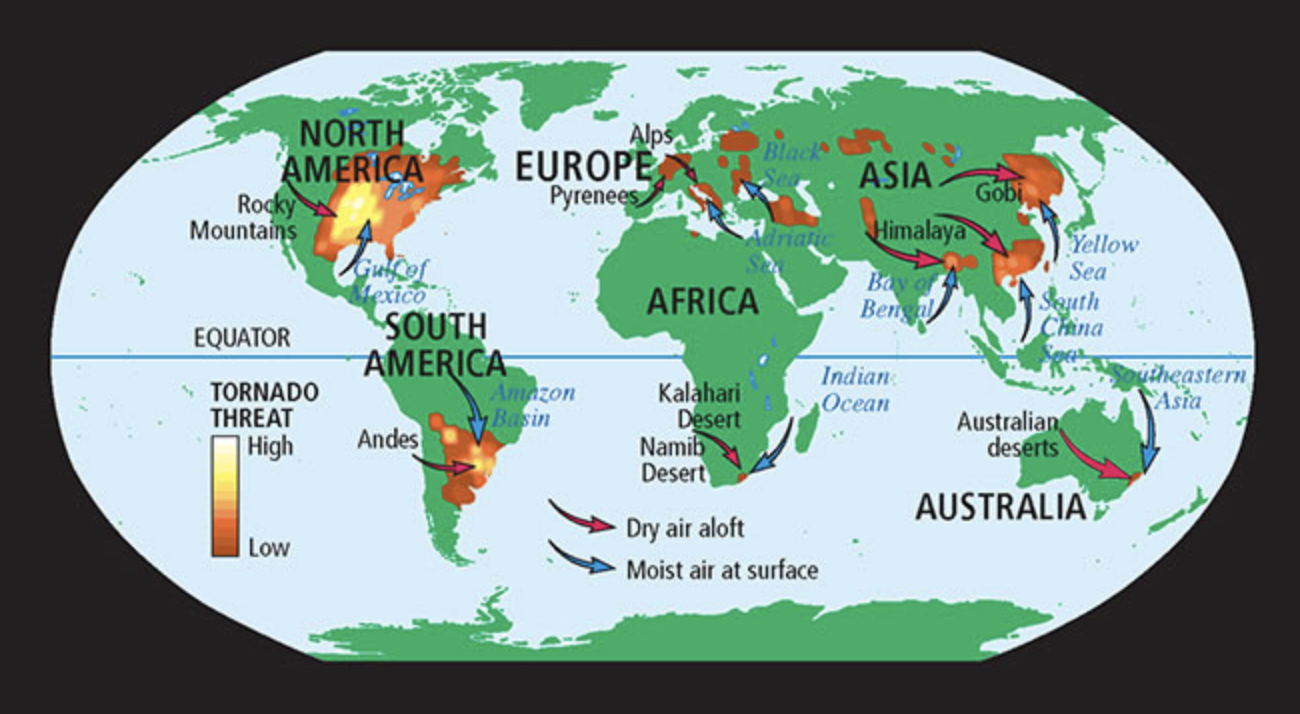
Look at this sweet World Tornado plot! We're #1! USA! USA! USA! :)
Blog Post #62. Thu Feb 19 13:35:33 2026. Jack Danser-Anger wrote:
I found this chunk of reading enjoyable and interesting. Specifically, the part about isostatic equillibrium and how Archimedes Principle applies to the mass distribution on planets. Also I personally had never heard of polar wander but it makes sense that a planet will just reorient itself to spin more effeciently based on mass distribution.
Blog Post #61. Thu Feb 19 12:53:53 2026. Shane Levay wrote:
The passage was more difficult to follow this time, as it combines multiple physical concepts without clearly separating them into conceptual sections before introducing the equations. I had a question about the moment of inertia ratio: if a planet has a ratio (I/(MR^2) that was significantly less than 0.4, what does that imply about the internal density distribution? Additionally, why do slow rotators like Venus complicate interpreting this value?
Blog Post #60. Thu Feb 19 12:08:01 2026. Jasmin Mohammadi wrote:
After reading 6.2, I had a question regarding polar wander. I understand that its due to a mass anomaly in a location other than the equator so the planet must reorient itself but why does this occur? Is it an argument of conservation of momentum? Also, how does the planet keep its rotation axis fixed despite the reorientation? What is reorienting itself? I'm having a hard time visualizing this process.
Blog Post #59. Thu Feb 19 11:53:14 2026. Ava Allen wrote:
Hello! While reading 6.2, and thinking about how Earth releases heat through tectonic activity, it made me think of the lack of plate tectonics on other planets. If Mars or Venus had plate tectonics, would their temperature have decreased more rapidly? If we could somehow trigger tectonics on Venus would this allow the planet to become a cooler, more habitable, place?
Blog Post #58. Thu Feb 19 11:11:33 2026. Debika Biswas wrote:
I had a question about isostatic equilibrium. The textbook talks about how large mass protrusions, like mountains in isostatic equilibrium, have less mass in the upper part of the mantle that is right below them. Is this true for all mountains? I am a bit confused because it says mountains particularly in isostatic equilibrium, but when it talks about the opposite, with oceans and basins, it implies that it holds for all of them. Overall, I liked this section as I don't think I have learned about this yet, and it was really interesting.
Blog Post #57. Thu Feb 19 09:47:28 2026. Caroline Wilking wrote:
@Joseph I found this article that talks about Sputnik Planitia, a basin on Pluto that caused a polar wander: https://www.nature.com/articles/nature20120
Blog Post #56. Wed Feb 18 15:56:36 2026. Joseph Kleinman wrote:
A few questions:
1. What would be an example of a "mass anomaly" that could cause polar wander?
2. Though geologically dead, Mars has an abundance of volcanoes. Could they have been formed by plate tectonics in the past, or a different form of tectonics?
3. Are Triton's geysers caused by Tidal heating like Enceladus or by some other factor?
Blog Post #55. Tue Feb 17 15:12:41 2026. Oliver O'Brien wrote:
I thought the equations for Jean's escape were really interesting. I think something similar has been covered in my previous astronomy classes, but I feel like this description both re-familiarized me with the material and helped me understand it better. I also didn't realize that impactors could have such a large (excuse the pun) impact on planetary atmospheres!
I have a couple of questions:
1. Does anyone know whether other planets have been (or could be) snowball planets at some point like Earth? Do any of the other planets go through similar warming/cooling cycles?
2. I learned a bit about Mars' potential for a sub-surface frozen sea containing most of the water ice on the planet in another class. Do we have any direct evidence of this besides the Phoenix Lander? Are there any planned missions to further test this hypothesis?
Blog Post #54. Tue Feb 17 14:28:01 2026. Gillian La Vina wrote:
(Also, thank you to @Oliver for answering my question -- seeing diagrams with wind lines helped me understand how hadley cells work!)
Blog Post #53. Tue Feb 17 14:19:35 2026. Gillian La Vina wrote:
When reading about the role of albedo in the atmosphere, I found it interesting how small changes can produce two possible positive feedback mechanisms that result in opposite extreme scenarios. This reminded me of unstable equilibrium points in classical mechanics, but with a lot more factors/nuance involved. Currently, do we know a specific range of albedo the Earth can have before the climate becomes irreversibly hot or cold, or are there too many other factors to pin down a specific albedo number?
Blog Post #52. Tue Feb 17 14:19:15 2026. Jack Danser-Anger wrote:
I enjoyed reading about the section on secondary atmospheres. The fact that the atmosphere changed since the creation of the terrestrial planets is not suprising but I had not thought about the reasoning behind that nor the fact that the gas giants have relatively maintained their primordial atmospheric composition.
Blog Post #51. Tue Feb 17 14:11:36 2026. Yixuan Peng wrote:
reference previous content, the upper atmosphere has the elements differentiated, sort of. It does make sense herein to have relate molecular cross-section and number density in the formulas. In the case, if a sufficiently strong solar wind crosses Earth's atmosphere, there should be high rate of charge exchange reactions. consequently, will there also be 'wind' blowing into space, if so, how much would this affect low orbit satellites.
also for distant planets, will they have relatively lower rate of hcarge exchange reactions, and if not, what will be the source of the charges, mere internal?
Blog Post #50. Tue Feb 17 13:48:32 2026. Thomas Kenna wrote:
I found 5.8 quite a lot easier to read and understand than 5.7. I found the non-thermal processes for gas escape to be quite interesting, especially in how they are able to quantify the amount of gas escaping from impact erosion. As for 5.8, I find it really interesting to think about how the different feedback loops work together. Like if Earth were to become a snowball earth, the frozen oceans would stop the absorption of carbon into the ocean however, the release of carbon through volcanic activity would continue. Therefore over time the greenhouse effect should increase and help get Earth out of it's Snowball state.
Blog Post #49. Tue Feb 17 12:01:54 2026. Shane Levay wrote:
I don't really have a question about these two sections; they seemed easier to digest for me. I do think it is interesting that a difference in a thick and barren atmosphere can come down to things like gravity, solar energy, and catastrophic collisions. The various escape processes are something I have never heard of, and they are very interesting to read about.
Blog Post #48. Tue Feb 17 11:29:57 2026. Caroline Wilking wrote:
I found sections 5.7 and 5.8 to be a little easier to understand and the content was quite interesting to me. This may be a silly question but I was wondering if Earth’s atmosphere would be oxidizing or reducing. In other words, what amount of hydrogen is considered substantial? Does H2O vapor in the air count toward the amount of hydrogen in the atmosphere, or does it have to be in other forms?
Blog Post #47. Mon Feb 16 22:07:37 2026. Evan Shipley-Friedt wrote:
Sections 5.7–5.8 contrast Earth’s long-term stabilization through silicate weathering with Venus’s runaway greenhouse, where increasing atmospheric H_2O strengthened infrared trapping and hydrogen escape removed the possibility of a regulating cycle. In a climate dataset I worked on, we observed increases in consecutive rainy days, which seems consistent with a warmer atmosphere holding more moisture and amplifying the hydrologic cycle.
Given that added water vapor enhances warming on short timescales while CO_2 removal through weathering operates only over geologic timescales, I’m trying to place persistent rainfall in this framework — does it mainly represent the fast radiative response of a moister atmosphere rather than any immediate stabilizing behavior of the climate system?
Blog Post #46. Mon Feb 16 18:28:49 2026. Jasmin Mohammadi wrote:
Just to answer Debika's question - You're exactly right I believe! Due to the exosphere's low density, the particles are so far apart that they never really collide with one another.
To answer Zya's question: from my understanding, it is possible for a mini body to form from large impacts (like how our Moon came to be), but the chances of it maintaining that atmosphere are pretty low do to the way the gas may spread after the impact. I think it is more likely for a small exosphere to form from impacts on the new body which contain volatile materials or releases some from the body itself.
I really enjoyed reading 5.7 and 5.8, the textbook felt more digestible in these chapters and I found it really interesting to learn about all the ways an atmosphere can come to be.
Blog Post #45. Mon Feb 16 17:08:02 2026. Zya Woodfork wrote:
This may be a silly question, but if a planet with an atmosphere were hit with a large impact, is it possible for the atmosphere and solid pieces of the planet that were launched out to condense into a sort of mini body (maybe a dwarf planet or an asteroid) with an atmosphere? I know a planet has to be of at least a certain mass to maintain an atmosphere, but could this tiny body form to have one temporarily? If not, when a large enough impact happens, where would that atmospheric material end up?
Blog Post #44. Mon Feb 16 16:39:21 2026. Debika Biswas wrote:
I had a question regarding 5.7. The textbook talks about how collisions between particles above the exobase more or less don't happen. Is this due to the low density of particles in the exosphere so the likelihood of particles colliding is very small or some other reason? Additionally, figures 5.11, 5.12, 5.14, and 5.15 helped to explain some concepts in 5.8 as I am a visual learner.
Blog Post #43. Mon Feb 16 14:43:26 2026. Joseph Kleinman wrote:
In 5.8, it claims that the Earth remained at a habitable temperature even with the sun being significantly fainter than today due to the different composition of the atmosphere, which has changed since then to keep the planet at around the same temperature. It is often said that Earth will become uninhabitable in around 500 million years because of the warming sun; however, would you predict that the atmosphere will continue to change (perhaps lifeforms evolve to belch out less CO2) to keep this equilibrium going, like it has been going for 3 billion years?
Blog Post #42. Mon Feb 16 14:09:44 2026. Xuge Wang wrote:
In 5.8, under the discussion of Mars atmosphere, it states that the lack of current tectonic activity and the recycling back of CO2 into the atmosphere. Does this mean that CO2 is underground currently? Also, how will this affect our plan for living on Mars generally?
Blog Post #41. Mon Feb 16 14:07:17 2026. Xuge Wang wrote:
Msg test for identification
Blog Post #40. Sun Feb 15 14:29:52 2026. Ava Allen wrote:
Hello! Two questions came to my mind while reading 5.7 and 5.8:
1. With impact erosion in mind, was Earth's atmosphere bigger/denser in the past? Like did the impact that killed the dinosaurs (or any other large impact in our history) cause us to lose a decent amount of our atmosphere?
2. Was the structure of our atmosphere the same since formation (ex. Hadley cells and wind directions)? The reading many focused on compositional evolution.
Blog Post #39. Thu Feb 12 17:46:27 2026. Prof. Doug Hamilton wrote:
@Jonah : The Clausius-Clapeyron EOS arises from a thermodynamics derivation. It lets you work out the water vapor carrying capacity of air at different temperatures. I found a nice derivation here .
Blog Post #38. Thu Feb 12 15:31:38 2026. Oliver O'Brien wrote:
I posted about today's readings on Tuesday, so I wanted to take some time to try to answer some questions people have been posting! I think everyone has some really interesting questions.
Thomas' Question About Jupiter's Bands: I did some Googling, and to my understanding, the bands are the way they are because Jupiter's fast rotation causes very strong winds. These winds group elements into bands, with lighter zones showing where water gas is rising up into the atmosphere and darker bands indicating where gas is sinking. Gas of a similar composition will thus be grouped into a band or zone depending on whether it's rising or sinking. I hope this is helpful!
Jonah's Question About the Clausius-Clapeyron EOS: I couldn't find a specific derivation of the version the textbook uses, but this page seems to be fairly close to the one that we have! In this case, they use the heat of vaporization, which is a form of latent heat.
Gillian's Question About Hadley Cells: I actually found a presentation from Dr. Hamilton that helps explain this! Essentially, the faster a planet rotates, the more Hadley cells it'll have due to the Coriolis effect.
Blog Post #37. Thu Feb 12 15:15:00 2026. Prof. Doug Hamilton wrote:
@Meghan : In Eq. 1 in section 5.5.1, hv represents energy delivered to the reaction by a solar photon. The photon must carry sufficient energy; here the wavelength must be less than 175 nm in the ultraviolet.
Blog Post #36. Thu Feb 12 15:12:20 2026. Debika Biswas wrote:
I have a question from 5.6 about eddy diffusion since the chapter only briefly goes over it. Since it occurs when the atmosphere is unstable against the turbulence, does eddy diffusion fluctuate based on the instability between the lower and upper atmospheres?
I have also heard of eddies in the ocean, how different are the two as I imagine they are connected somehow but different because one is in water and one is in the atmosphere.
Blog Post #35. Thu Feb 12 15:09:40 2026. Yixuan Peng wrote:
reference 5.5, and preceding posts related to ozone layer and life, it seems the existence of ozone is a mere indication of existence of oxygen. the photodissociation and recombination cycle. and seems only reaction (1) and (5) can effectively block UV light. (also, ion recombination is slower than molecular recombination)
reference 5.6, does a limiting flux related to if a planet is able to retain its atmosphere?
Blog Post #34. Thu Feb 12 15:04:26 2026. Prof. Doug Hamilton wrote:
Lots of great questions here! Bring 'em to class. I can occasionally answer some of them here. For example, take a look at section 4.1.3 and Eq. 4.17 for a quantitative discussion of equilibrium temperature.
Blog Post #33. Thu Feb 12 14:53:10 2026. Ava Allen wrote:
Just to answer Jack's question from earlier today: both reasons are important when we look for the presence of ozone! In particular, ozone is sometimes considered a biosignature, meaning it could indicate life, so I think its role as a product of life is more important.
Blog Post #32. Thu Feb 12 14:48:29 2026. Meghan McKenna wrote:
In the photolysis and recombination section (5.5.1) what does the hv mean in equation (1)?
Blog Post #31. Thu Feb 12 14:44:15 2026. Joseph Kleinman wrote:
When talking about processes of planetary atmospheres, including photochemistry and photoionization, are these processes the same on gas giants as on the terrestrial planets due to the sheer abundance of gas? If not, what's different and why?
Blog Post #30. Thu Feb 12 14:17:02 2026. Jack Danser-Anger wrote:
I noticed that the chapter of ozone mentioned that the existence of ozone is a great indicator of potential life - is this becuase of life processes that help to form the ozone, or just that its hard to find a habitable planet that does not have an ozone layer? Aside from that bit of confusion, the information on how it is actually produced and the role that the photoionization of molecules plays was interesting to read about. I don't think I fully grasped the idea of where ionospeheres come from and why they form, but I understand what they are.
Blog Post #29. Thu Feb 12 13:09:41 2026. Gillian La Vina wrote:
Reading about oxygen chemistry on Earth: Is an Ozone layer the only way to support habitability/life on other planets? Or are there other kinds of molecules or substances that could protect a planetary surface from UV? Similarly, is there a well-defined amount of UV radiation that can penetrate an atmosphere before a planet is considered inhospitable to life? Tangentially related, but moving forward, how important is to be familiar with chemical reaction equations to understand the role, dynamics, etc. of atmospheres?
Blog Post #28. Thu Feb 12 12:45:30 2026. Gillian La Vina wrote:
Reading 5.4, I had some questions about Hadley cells and cell circulation that I feel the textbook glossed over a bit.
What are the physics mechanisms that gives faster rotating planets more cells?
Also, the “middle” cell on Earth (between the polar and hadley cells at the center of the hemisphere), the Ferrel cell, why would air rise at the cold end and sink at the warm end? Does it have to do with the influence of the other cells?
Blog Post #27. Wed Feb 11 20:12:01 2026. Thomas Kenna wrote:
Just finished reading 5.5 and 5.6 - The part that drew my interest the most was the discussion on Nitric oxides. In particular when it stated that the harmfulness of nitric oxides in the troposphere was unknown and I'm interested to see how this changes as more research is done.
Also, I believe Oliver is correct about the 'internal gravity waves' being produced by the fluid itself. I did some extra googling and found out that in Earth's atmosphere, internal gravity waves can be cause by the presence of mountains and storms.
Blog Post #26. Wed Feb 11 19:57:03 2026. Zya Woodfork wrote:
This might be a silly question, but how can we tell if eddy diffusion or molecular diffusion is taking place in a particular area? If a whole pocket of air is moving, individual molecules are moving within it, so how do you differentiate the two?
Blog Post #25. Wed Feb 11 19:51:27 2026. Caroline Wilking wrote:
As we get further into the book, I am finding the scientific language a bit harder to understand, especially in sections 5.5 and 5.6. I'm excited to talk about these sections in class to hopefully better my understanding of the content. One thing I learned that I probably should have already known is that ozone is defined as O3.
Blog Post #24. Wed Feb 11 16:02:49 2026. Jasmin Mohammadi wrote:
I thoroughly enjoyed reading about how photochemical reactions change atmosphere compositions and the way constitutents move around the atmosphere through various methods of diffusion! I was particularly interested in the description of the reaction that creates ozone, as this it is something we often search for on other planets for an indication of life. Planetary sciences is honestly a field that is pretty new to me so it's interesting to read about all the components that must be taken into consideration when observing a planet and the various phenomema that can occur on it.
I did have a quick question regarding the vertical flux - Do we have any equation to describe this result or would it just be a numerical answer that we can observe? I understand it depends on the net molecular diffusion coefficient, but is there anything else that must be taken into consideration?
Blog Post #23. Tue Feb 10 16:49:10 2026. Jonah George wrote:
In 5.3, in my opinion it would have been interesting to see a derivation of the Clausius-Clapeyron equation of state rather than it just being stated. (Maybe in one of those "reading optional" text boxes authors sometimes include.) I found the part of 5.4 about the Coriolis effect relatable to what I learned in classical mechanics.
Blog Post #22. Tue Feb 10 16:48:48 2026. Jonah George wrote:
While I have learned about the atmosphere of Earth especially in thermodynamics and theoretical astrophysics, 5.1 certainly describes it in more detail as well as elucidating the details of the atmospheres on other planets. It was also interesting to learn more about the composition in 5.2.
Blog Post #21. Tue Feb 10 16:48:40 2026. Yixuan Peng wrote:
reference chapter 5.3. It is quite interesting thinking about how frequent exponential funcitons appear in the field of astronomy, while considering various physical constraints these all presenting reasonable models. The function of clouds are also interesting as they both reflect off sunlight from outside and infrared radiation from inside. I wonder if there is, if possible, any methodology to determine when greenhouse effect dominates (so temperature increase), and when otherwise (cooling the surface of the planet).
reference chapter 5.4. The winds on other planets are a bit hard to imagine. in the section of condensation flows, it is impressive that, on Io there can have supersonic day-to-night winds, since its thin atmosphere. while the discussion in the chapter does not mention Mercury, guess its ''atmosphere'' is too thin to be considered, despite the incredible day/night temperature difference.
Blog Post #20. Tue Feb 10 16:48:13 2026. Jonah George wrote:
Hello everyone,
I have enjoyed this book so far; I think the introduction was quite good as it described many different objects in good detail, as well as explaining a wide variety of terms/definitions. It was a good review from ASTR120/121 for me as I have not remembered everything.
Blog Post #19. Tue Feb 10 16:48:06 2026. Thomas Kenna wrote:
Hi everyone!
What stood out to me most from the reading was how cool it was to compare the weather on different planets. Despite having different elements on each planet, the way the weather works is relatively the same. For example, we know Earth has polar ice caps and Mars does too except Mar's 'ice' caps are made up of CO2.
In addition, after doing the reading I took some time to look at a photo of Jupiter and could see all of the weather systems that were discussed in the reading. Such as, the different cells which are visible through Jupiter's bands however I do wonder why different elements seem to stick in certain bands? Also, Looking at the red spot I was able to confirm it's an anticyclone just by looking at it as it's in the southern hemisphere and rotates anticlockwise.
Blog Post #18. Tue Feb 10 16:48:04 2026. Oliver O'Brien wrote:
Hi everyone!
I found it really interesting that certain layers of the atmosphere (specifically the D and F2 layers) are usually absent at night. It makes me wonder how this occurs on other bodies with atmospheres. I also was wondering if anyone understood this quote from Section 5.6.1 (page 128): "In subadiabatic regions, eddy diffusion may be driven by internal gravity waves or tides." What exactly are internal gravity waves here? I'm assuming tides have to do with a potential moon or host star relation, but is this referring to gravitational waves produced by the body itself?
To answer Joseph's question from Saturday about Mars' and Triton's clouds (or lack thereof), I believe Mars and Triton don't have significant atmospheres because they don't have significant sources to keep one in place. Page 112 of the textbook says that their atmospheres are mainly contributed to by the sublimation of ices, and though both bodies have ice, I don't think this is enough for either to have significant clouds/atmospheres. On Earth, we have volcanic outgassing as the main geological contributor to our atmosphere in combination with human activity and oxygen from photosynthesis.
Blog Post #17. Tue Feb 10 13:09:56 2026. Shane Levay wrote:
Something I found interesting was section 5.4 on meteorology. At the edge of a cloud, having relative humidity less than 100 percent makes sense, but when you get to the middle, it can be up to 107 percent, meaning that there is supersaturated vapor within the cloud. This surprised me because I always thought the relative humidity limit was 100 percent. Something that confused me was also in this section, because how can a supersaturated vapor form in a cloud? Wouldn't it just condense out?
Blog Post #16. Tue Feb 10 13:01:02 2026. Jack Danser-Anger wrote:
I found it really intereting how different heat sources and collision factors and properties of air can give us the temperature gradient seen in the atmospheres of Earth and Titan (and maybe Saturn). I am a little confused about the difference between observed effective temperature, and equillibrium temperature and would appreciate if that could be explained a little further.
I'm also curious about the reliability of in situ measurements and how much we trust those individual probes or rovers when attempting to quantify an unknown atmosphere.
Blog Post #15. Tue Feb 10 11:51:51 2026. Debika Biswas wrote:
After doing the reading, particularly 5.4, I am curious about how the different gasses present in an atmosphere relate to the pressure gradients and in consequence the winds caused by solar heating. I could be incorrect, but I imagine that that the weights of the gasses in each of the planet's atmospheres would effect the pressure and winds. Thanks!
Blog Post #14. Tue Feb 10 10:59:39 2026. Zya Woodfork wrote:
The plots on page 112 give a lot of useful information about planetary atmospheres, but I'm having trouble figuring out how to read them (especially the ones for Earth, Venus, and Mars). Could we potentially go over how to read one in class?
On another note, I found section 5.3 really interesting. I know how important an atmosphere is for a planet to be habitable, but I didn't realize clouds play such a large role as well by reflecting and absorbing heat and increasing the greenhouse effect.
Blog Post #13. Mon Feb 9 22:56:29 2026. Ava Allen wrote:
Hi everyone!
While I already knew Titan's atmosphere was an interesting area of research, I was surprised to read about its' similarities to Earth's. I didn't know they were the only 2 with multiple temperature minimum layers. I wonder how this trend may vary on other planets outside our Solar System? Its unfortunate we don't have many other solid bodies with liquid on the surface in our Solar System to compare these to.
Blog Post #12. Mon Feb 9 20:04:01 2026. Caroline Wilking wrote:
I thought it was very interesting how the presence of CO2 in Venus's atmosphere creates a very strong greenhouse effect, causing extremely high surface temperatures, while on Mars CO2 acts as a cooling agent.
One question I had was about the mesopause. The book explains that Earth, Titan, and possibly Saturn have this second temperature minimum but does not explain why this may be the case. Do we have any ideas as to why this only shows up on 2-3 objects in the Solar System?
Blog Post #11. Mon Feb 9 17:56:41 2026. Jasmin Mohammadi wrote:
This might be a bit of a silly question but is there anything that can cause a stationary eddie to move? In the book they are defined as non-propagating storms in an atmosphere - is it the kind of thing that once it forms it's there for life? If they can move, where does the line between an eddie and a storm get drawn, or are these terms synonomous?
Blog Post #10. Mon Feb 9 15:17:34 2026. Evan Shipley-Friedt wrote:
In the opening chapters, I was struck by the discussion of planetary temperature and the greenhouse effect, particularly the emphasis on energy balance and atmospheric composition rather than distance from the Sun alone. The contrast between Earth and Venus makes clear how changes in infrared absorption can drive large differences in surface conditions, even when the underlying physics is the same.
That framing made me think about how sensitive planetary climates can be to relatively small changes in atmospheric properties. While the mechanisms themselves operate within a well-understood physical framework, the consequences can still be severe on much shorter timescales than planetary evolution as a whole. I’m interested in how planetary science helps clarify that distinction and what it implies for interpreting current climate trends.
Blog Post #9. Sat Feb 7 18:39:21 2026. Joseph Kleinman wrote:
Cloud structure on other planets is something I don't know a whole lot about, and so I have a few questions. One is why are Mars's clouds so "whispy" if it were, not having the volume and structure of Earth's lower-atmosphere clouds. Is it something to do with their composition, the gravity, or the temperature? Also, I know Triton has a very thin atmosphere. Is there any significant cloud formation there?
Blog Post #8. Sat Feb 7 08:38:45 2026. Prof. Doug Hamilton wrote:
This is a good time to point out this link: Book Errata. You found an error in the textbook Oliver, good job!
Quoting from the updated Errata Page: "The curves for Figure 5.1 are not defined (Credit: Oliver O'Brien). In the graduate version of the textbook this is Fig. 4.1 and the two curves are defined in the figure caption. The solid curve shows the measurements of Cassini's Huygen's probe which descended through Titan's atmosphere. The dashed curve is the engineering model used by Huygen's planners to prepare for the mission. This engineering curve should probably be removed from the figure for clarity."
Blog Post #7. Thu Feb 5 15:15:08 2026. Oliver O'Brien wrote:
Hi everyone!
I agree with what was said earlier about the first set of readings. I was surprised at how in-depth the appendices of the textbook are, especially Appendices E and F!
I had a question about Figure 5.1. Does anyone know which line is which for the Titan diagram? I think it's interesting how one seems to be much more variable than the other.
Also, to answer Jasmin's question about the saturation vapor pressure curve, from my understanding, the curve shows the maximum pressure that water can be at for each temperature. At the pressure shown by the curve, the environment is saturated with water, so it can't hold any more of it. Water can exist at any pressure below the curve, but the saturation curve sets the upper limit for how much water a system can hold. I hope this makes sense (and is fairly accurate)!
Blog Post #6. Wed Feb 4 22:41:26 2026. Jasmin Mohammadi wrote:
I had a question about a part of 5.3 - I don't think I entirely understand how we can use the saturation vapor pressure curve to determine how much water vapor is able to exist in the air. What is the correlation between the plots and the amount of water vapor? I understand that we can use the plot to tell what phase it is in, but I'm not sure what else we can get from it.
Blog Post #5. Tue Feb 3 15:13:46 2026. Jasmin Mohammadi wrote:
Hi everyone! I personally found the textbook chapters very helpful as an introduction to this class. I do not have much experience in planetary sciences so I'm looking forward to exploring a new branch of astronomy and I felt the book was written in a way that made its content very digestible. One area of the textbook that I am excited to read about is how we can understand more about our early Solar System through the composition of comets and asteroids (Chapter 12).
Blog Post #4. Tue Feb 3 15:13:27 2026. Debika Biswas wrote:
Hi everyone! I am excited for this class and found the readings to be very helpful. They provided a nice review of content from ASTR120, as it has been a while since I took it. I also appreciated the brief introduction for some newer content like hydrostatic equilibrium. The appendices were also very helpful. Additionally, I do research with comets, so I am excited to learn more and apply that information. Thanks!
Blog Post #3. Tue Feb 3 15:04:04 2026. Ava Allen wrote:
Hello! I found the tour of our Solar System very interesting! I hope to research large moons in our outer Solar System so I particularly liked the overview of those (especially ocean worlds). The appendices in the back are very helpful and I often forget to check those. This chapter was very similar to my first reading for my Geology of Terrestrial Planets course, so I feel very prepared to learn more about our Solar System this semester!
Blog Post #2. Tue Feb 3 11:38:57 2026. Yixuan Peng wrote:
reference slides Ch1.pdf. It is a review, while the visual comparision of such many objects is quite interesting. Most content was remembered from astr120-121 sequence.
reference textbook Preface, Chapters 1, 2.1.1, 3.2 and look over Appendices A-F. Kepler related content was familiar from previous classes, while the formulas does seems to have further detailed. Chapter 3.2 contains mostly new content, while ideal gas law being a only connection to previous knowledge. Appendices are useful contents, wherein the rocket engine structure illustration was of particular interest.
Blog Post #1. Sun Jan 25 16:18:38 2026. Prof. Doug Hamilton wrote:
Welcome to the Fundamental Planetary Science Reading Log! I hope that this tool will help make reading the textbook easier and more fun as we are all in it together. If you keep up with the reading, you'll have a much better understanding of what is going on in class, you'll do better on exams, and you will be able to make better contributions here. Please post questions about the
reading, answers to questions from others, comments on the coolest new
thing that you learned, compliments or gripes about the writing, etc.
- Step 1: Always do the reading assigned for a given lecture!
- Step 2: When you are finished, post something good here!
Your Reading Log posts count towards your class participation grade, so please make an effort to participate. I expect everyone to post something before the second week of classes.
 Return to the ASTR430 main page